Highly Sensitive Toolkit
Learn how ADHD dopamine cycles affect motivation, focus, and energy.
Start Here
Welcome to the ADHD Dopamine Support Workshop!
Start here to understand how the course works and how to move through the lessons.
What is Dopamine & Why Does It Matter for ADHD?
Dopamine is a brain chemical that affects motivation, focus, and reward-seeking behavior. It’s what gives you that “yes! I want to do this” feeling.
ADHD brains don’t produce or regulate dopamine the same way neurotypical brains do. This often leads to:
🔹 Craving stimulation—scrolling, shopping, snacking, or jumping between tasks for a quick dopamine hit.
🔹 Struggling with motivation—if something isn’t urgent or exciting, it’s hard to start or stay focused.
🔹 Feeling stuck in a dopamine loop—constantly chasing quick rewards but feeling drained afterward.
This course will help you reset and rebalance dopamine so that:
✔️ You feel more in control of your focus and energy.
✔️ You avoid burnout and overstimulation.
✔️ You create balance between fast and slow dopamine—so your brain works with you, not against you.
What to Expect
This course is designed to be ADHD-friendly, flexible, and doable—even on tough days.
✔️ Short audio/video lessons (5-10 minutes each)
✔️ No rigid rules—just simple, effective strategies
✔️ Practical tools you can use immediately
You’ll learn why ADHD brains chase dopamine, how overstimulation leads to burnout, and simple ways to reset without guilt or restriction.
How to Move Through This Course
🟡 Lessons 1-4: Understanding dopamine, impulsivity, and balance
🟢 Lessons 5-6: Quick tools to reset your brain & motivation
🔵 Lessons 7-8: Daily check-ins and long-term strategies to keep it going
You don’t have to complete this all at once.
Take it at your own pace. Come back to lessons as needed.
No perfection required—just progress.
Dopamine for ADHD Affirmations
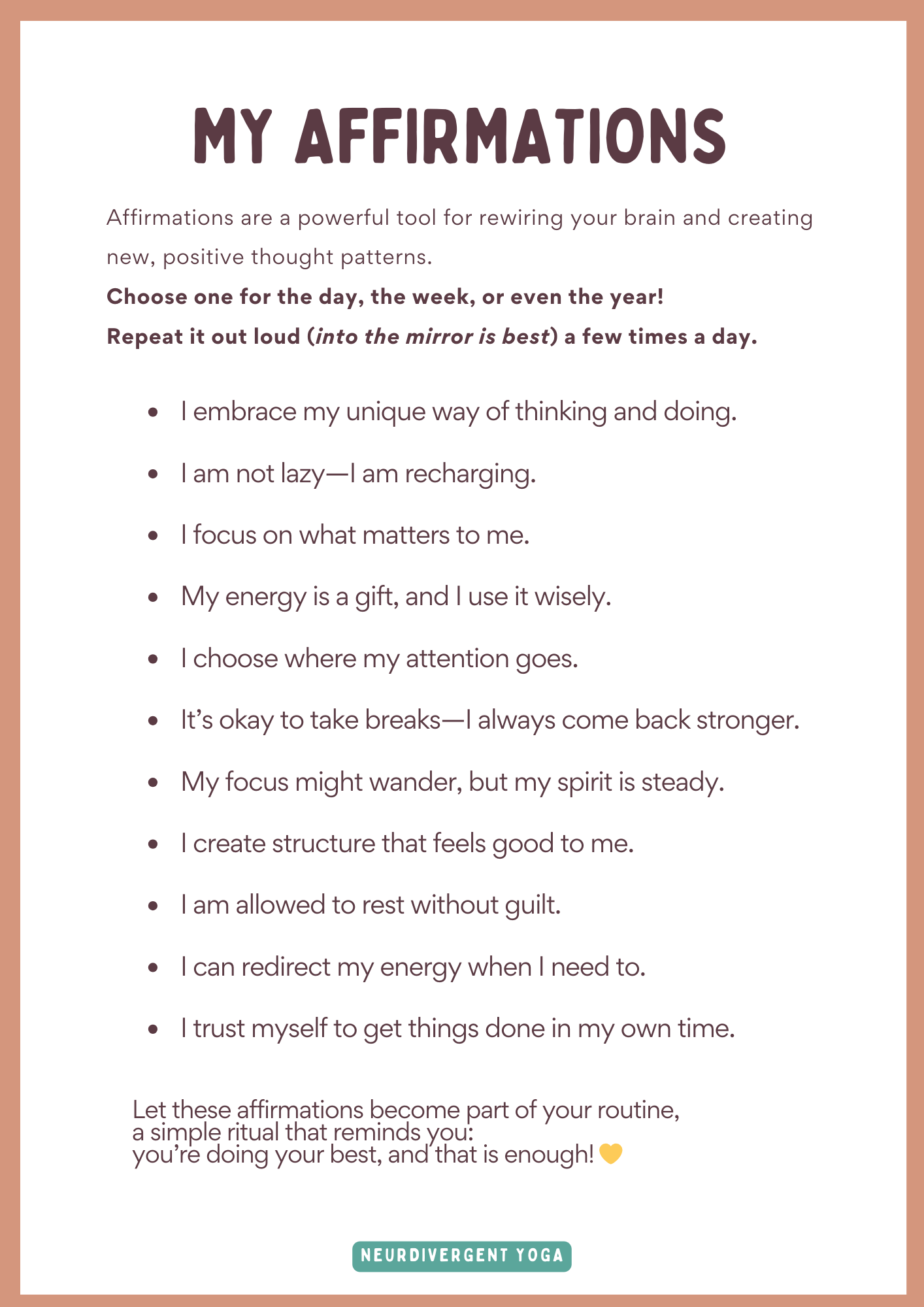
ADHD brains respond well to quick, simple reminders that help us stay grounded, focused, and motivated. These affirmations aren’t about forcing positivity—they’re about giving yourself the right kind of reinforcement as you move through this course.
Our brains often get stuck in negative thought loops when we feel overwhelmed, frustrated, or stuck in distraction cycles. Affirmations work by interrupting those patterns and reminding you of what’s actually true.
How to Use These Affirmations:
✔️ Read them daily—in the morning, before starting a lesson, or whenever you need a reset.
✔️ Say them out loud or write them in your notes.
✔️ Use the downloadable sheet to keep them visible on your phone, computer, or printed out.
⤵️Click the image below to download.
1- Why Your Brain Craves Quick Dopamine
If you’ve ever caught yourself doom scrolling, impulse buying, or jumping between tasks and wondered, Why do I do this?—you’re not alone. I’ve been there too, and guess what? It’s not a flaw, it’s your brain looking for dopamine.
Dopamine is what makes things feel interesting, exciting, and worth doing—and ADHD brains don’t regulate it the same way neurotypical brains do. That’s why starting things can feel impossible but binge-watching a show for six hours? No problem.
I used to think I just had no willpower, but once I understood how dopamine actually works, things clicked. This lesson is all about that—understanding your brain so you can work with it, not fight against it. No guilt, no shame—just awareness.
🎥 Watch the Lesson 1 Video – Let’s break down why ADHD brains crave quick dopamine.
📝 ADHD Dopamine Awareness Tracker
Track Your Dopamine Patterns Without Pressure
ADHD brains are wired to seek dopamine, often without us even realizing it. Some activities give us quick dopamine hits (like scrolling or snacking), while others provide long-lasting focus and balance (like movement or deep work).
This tracker is designed to help you notice your patterns—without guilt, without pressure, just curiosity.
✔️ Simple & Flexible – No strict rules, just a space to reflect.
✔️ Takes Only a Few Minutes – Track as little or as much as you want.
✔️ Helps You See What Works for You – Awareness is the first step to balance.
How to Use The Google Doc:
1️⃣ Make a COPY of the Google Doc⬆⬆⬆
2️⃣ Fill in the blanks when you notice moments that you seek dopamine.
3️⃣ Note how you felt before and after.
4️⃣ Look for patterns over time—are some habits energizing? Are others draining?
No right or wrong answers, no pressure to track EVERYTHING—over time you'll see patterns to help you better understand how your brain and body respond.
2- What Is A Dopamine Crash?
The Dopamine Crash: Why We Feel Drained & Scattered
So, you know that instant hit of excitement when you start something new—only to feel completely drained an hour later? Or when you go on a social media deep dive and then can’t focus on anything else? That’s a dopamine crash, and it’s one of the biggest reasons ADHD brains swing between hyperfocus and burnout.
Here’s the thing—dopamine isn’t just about motivation. It’s also about energy regulation. When we overload on fast dopamine (scrolling, snacking, online shopping), our brains get a quick high... and then crash, leaving us feeling foggy, restless, and unfocused.
This lesson is all about learning to recognize the crash before it happens and shift toward balance—without giving up the things you love.
🎥 Watch the Lesson 2 Video – Learn how dopamine crashes affect your focus and energy.
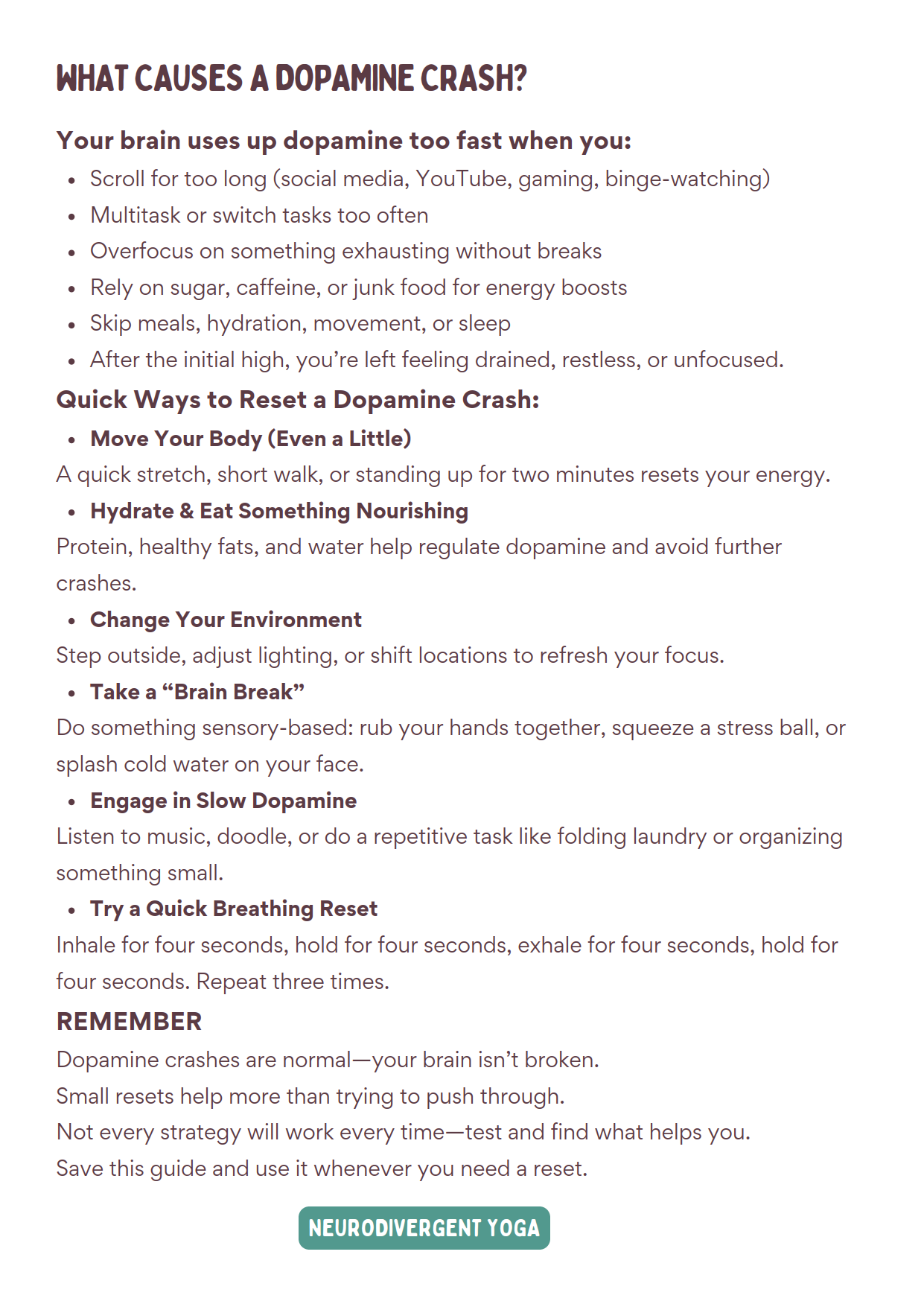
📝 Dopamine Crash Awareness Guide
How to Use the Dopamine Crash Awareness Guide
ADHD brains burn through dopamine fast—this is why we swing between hyperfocus and exhaustion, motivation and brain fog. One minute, you’re deep into something, the next, you can’t focus at all. That’s a dopamine crash.
This guide is here to help you:
✔️ Recognize when a crash is happening instead of feeling stuck in frustration.
✔️ Understand what’s triggering it so you can shift your habits in a way that actually works for you.
✔️ Use simple, holistic resets to recover faster—without guilt, pressure, or perfection.
How to Use This Guide
Check the crash triggers—see if any match what you’re experiencing.
Pick one or two reset strategies—test what works best for you.
Use the guide whenever you feel scattered, drained, or overstimulated.
There’s no right or wrong way to feel—this is about noticing how small shifts can big changes over time.
⬇️Click the image below to download.
3- The 72-Hour Rule
A Game-Changer for ADHD Impulsivity
Ever felt totally convinced you needed something, only to wonder why on earth you bought it a few days later? That’s ADHD impulsivity at work. When we get fixated on something—whether it’s a purchase, a new hobby, or even a big life decision—it’s often fueled by fast dopamine.
Here’s the thing: Impulse decisions aren’t always bad—but when they’re driven by dopamine spikes instead of actual needs, they can lead to regret, clutter, or financial stress.
That’s where the 72-Hour Rule comes in. Instead of trying to force willpower, this method helps you interrupt impulsive urges just long enough to see if they’re truly worth acting on. This isn’t about restricting yourself—it’s about giving your brain the time it needs to make choices you actually feel good about.
🎥 Watch the Lesson 3 Video – Learn how the 72-Hour Rule can help you pause impulsivity without relying on willpower.
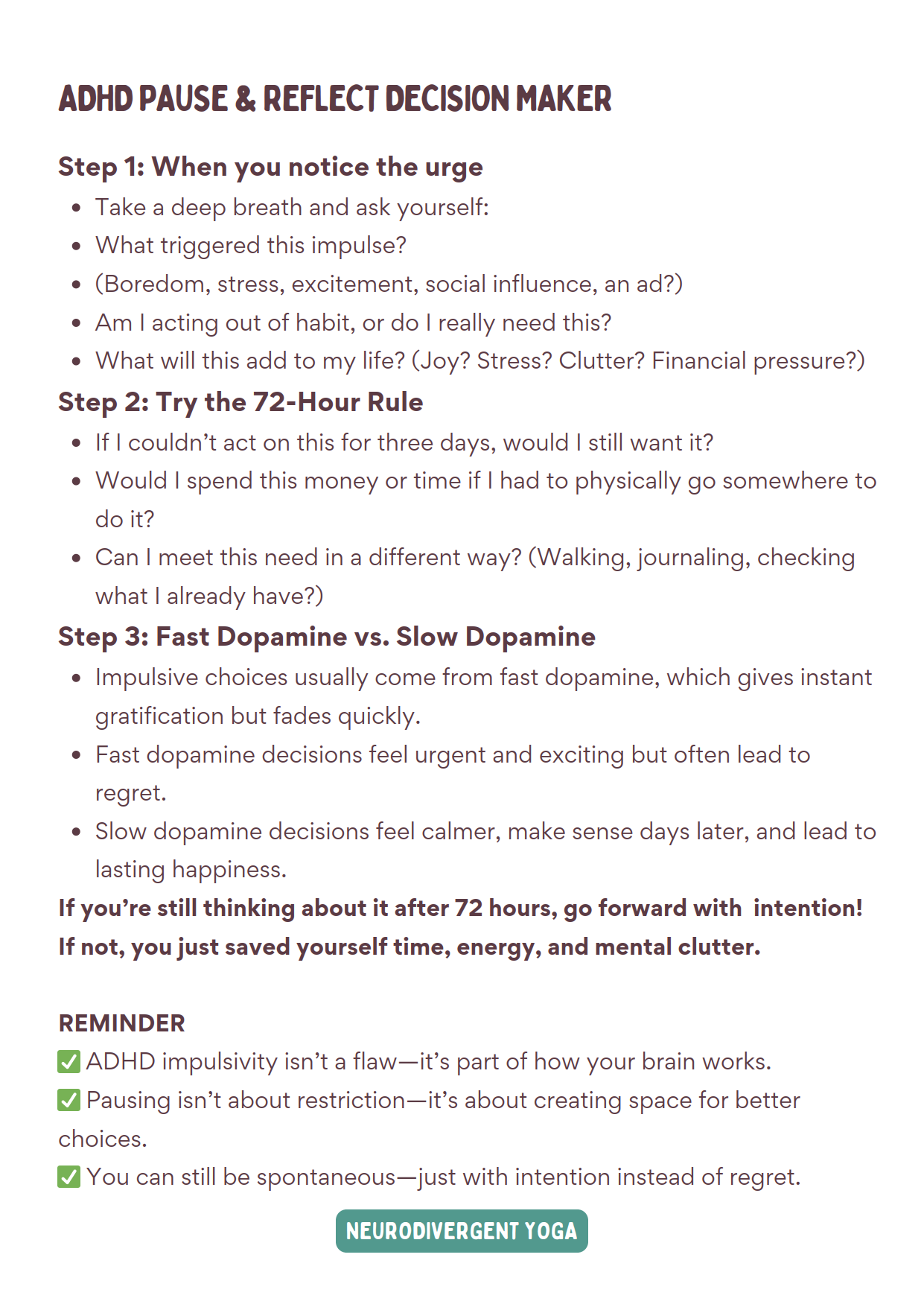
📝 The ADHD Pause & Reflect Decision Maker
How to Use the ADHD Pause & Reflect Decision Maker
ADHD brains love instant rewards—whether it’s impulse shopping, overcommitting, or diving into a new hyperfocus hobby. The problem? What feels exciting in the moment doesn’t always feel good later.
The 72-Hour Rule is a simple way to pause impulsivity without relying on willpower. Instead of feeling deprived, you’re giving your brain time to process whether this decision actually makes sense for you.
This tool helps you:
✔️ Recognize impulsive decisions before they happen
✔️ Separate fast dopamine urges from true long-term desires
✔️ Make choices that feel good days, weeks, and months later
How to Use It
When you feel the impulse to buy, commit, or start something new, stop and scan this guide.
Use the reflection prompts on the next page. Even pausing for 60 seconds can shift your brain into a calmer, clearer state.
Wait at least 72 hours (or as long as possible) before making the decision. If the desire sticks around, it’s likely a true need, not just fast dopamine.
No guilt, no pressure—just a tool to help you make decisions that actually support you.
⤵️Click the image below to download.
Fast vs. Slow Dopamine
4- How to Create Balance
Ever notice how some activities feel amazing in the moment but leave you feeling drained after?
While others don’t feel as exciting upfront but actually make you feel good for hours?
That’s the difference between fast dopamine (instant gratification, quick highs) and slow dopamine (lasting motivation, deep focus). ADHD brains naturally crave the fast stuff—it’s how we seek stimulation and avoid boredom. But when we rely too much on fast dopamine, we burn out, struggle with focus, and feel restless.
This lesson is about finding a balance that actually works for you—not cutting out fast dopamine completely, but learning how to add more slow dopamine so you don’t feel drained and distracted all the time.
🎥Watch the Lesson 4 Video – Learn how to balance fast and slow dopamine without guilt.
📝 Your Dopamine Balance Habit Builder
Work With Your ADHD, Not Against It
If you’re anything like me, fast dopamine runs your day—scrolling, jumping between tasks, chasing that next hit of excitement. It’s not a bad thing, it’s just how our brains work. But too much fast dopamine? That’s when we crash.
This guide isn’t about giving anything up—it’s about adding in slow dopamine so your brain has both quick wins AND lasting motivation. Small shifts, no pressure, just an experiment to see what actually helps you feel better.
✔️ Super simple—reflect, experiment, adjust.
✔️ No strict rules—just find what works for you.
✔️ Takes just a few minutes a day—because ADHD brains don’t do complicated.
I’ve made this easy to use—Dopamine Balance Habit Builder is a google doc you can make a copy of and use as many times as you need!
The Dopamine Reset Breath
5- Calm Your Brain in 60 Seconds
If you’re anything like me, you’re constantly seeking stimulation. Scrolling, switching tasks, feeling pulled in different directions—it’s like your brain is always on the hunt for something. That’s dopamine in overdrive.
Here’s what I’ve learned: Your breath is a built-in reset button.
I teach this because I know it works. It’s not an instant fix, but with time, practice, and commitment, breathwork can help regulate dopamine and bring a steady, grounded focus. Instead of trying to force yourself to concentrate or power through, you’re giving your brain what it actually needs—oxygen, space, and a way to reset.
This lesson is all about using your breath to support your ADHD brain. No complicated techniques, no need to sit still for long periods—just something simple you can do anytime, anywhere.
🎥 Watch the Lesson 5 Video – Why breathwork helps ADHD brains reset dopamine.
The best way to learn this is to actually try it.
Challenge:
Use this breathwork reset 3 times this week.
When you feel restless, overstimulated, or stuck, just pause and breathe.
It might not feel like much at first, but over time, you’ll start to notice the difference!
6- Willpower Isn’t The Answer
If you’ve ever had a million things to do but couldn’t get yourself to start, you know how frustrating ADHD motivation can be.
One minute, you’re hyper-focused and unstoppable.
The next, even simple tasks feel impossible.
I teach this because I know what it’s like to feel stuck. And I also know that ADHD motivation doesn’t work the way we’ve been told it should.
Willpower isn’t the answer.
Forcing yourself doesn’t work.
What does work?
Understanding how dopamine fuels motivation and learning how to activate it intentionally.
This takes practice, but once you get it, you’ll never see motivation the same way again.
🎥Watch Lesson 6 – Learn why ADHD motivation feels unpredictable and how to work with it.
Challenge: Try one small dopamine shift today.
💡 If you’re stuck, change something tiny.
Stand up, drink water, move to a new spot, play music, shake out your hands.
ADHD motivation needs movement—BOTH physically and mentally.
7- Make Small Changes Before You Burnout
ADHD Dopamine Check-In: A Daily Reset for Your Brain
Ever feel like some days your brain just works and other days, nothing clicks? ADHD dopamine levels fluctuate constantly, which is why focus and energy can feel so unpredictable.
But here’s the thing—you don’t have to wait for motivation to magically show up. A simple check-in can help you see where your dopamine is coming from and make small shifts before you crash or burn out.
I teach this because I know it works. When you get into the habit of noticing your patterns, you gain control over how you feel. This isn’t about guilt or tracking every move—it’s about learning what helps your brain feel good consistently.
This lesson is all about:
✔️ Checking in with your dopamine before you get stuck in distraction or burnout
✔️ Making small adjustments instead of reacting when motivation drops
✔️ Building a habit of awareness—without pressure, without tracking every little thing
🎥 Watch Lesson 7 – Learn how a simple dopamine check-in can help you stay balanced.
📝 ADHD Dopamine Check-In Prompts –
A quick, no-pressure way to notice where your dopamine is coming from today.
⤵️Click image to download.

8- Bringing It All Together
Over the past lessons, you’ve explored how dopamine impacts your focus, motivation, and daily energy—and, most importantly, how to adjust in ways that actually work for you.
Dopamine balance isn’t a one-time fix—it’s a practice. Some days, you’ll feel on top of it. Other days, not so much. That’s normal. The goal isn’t perfection—it’s learning how to notice what’s happening and shift when you need to.
We'll review:
✔️ Recognizing your dopamine cycles in real life
✔️ Letting go of all-or-nothing thinking
✔️ Using what you’ve learned in small, everyday ways
🎥 Watch Lesson 8 – A final check-in to help you integrate what you’ve learned.
Now that you've complete the course remember this isn’t about doing everything right—it’s about knowing you can adjust at any time.
Even one small shift makes a difference.