
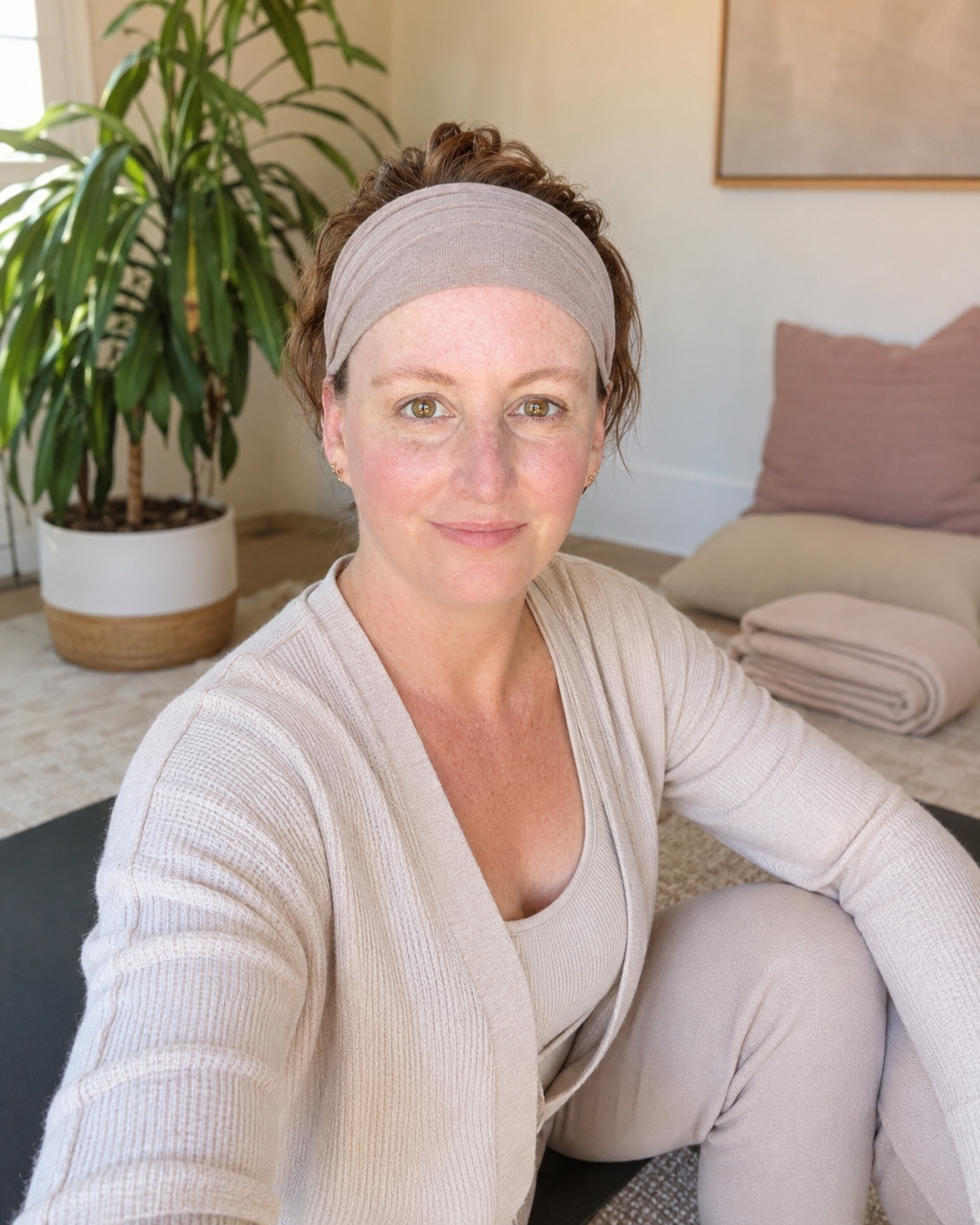
Hi, I'm Tonya.
I found yoga in the 1990s, and it stayed with me. But my relationship with yoga wasn't always easy.
I loved the idea of yoga, yet I often felt like I wasn't quite getting it right. I struggled with classes, with the expectations, with the idea that there was a right way to practice and a right way to be a yoga student. Practicing at home often felt more natural because I could slow down, stop, repeat something, or do something differently without feeling like I was falling behind.
I didn't understand why any of that mattered at the time.
I just knew that I loved yoga and, at the same time, often felt like I didn't quite fit in.
Over the years, I practiced, studied, taught, and kept coming back to the deeper teachings. I became less interested in yoga as something we only do on a mat and more interested in what it has to say about attention, change, rest, relationships, self-study, and how we live.
Then I discovered I was neurodivergent in my late 40’s!
That gave me a new way of understanding some of those old experiences. It also changed the questions I was asking about yoga. What if the problem wasn't that I wasn't good at yoga? What if some of the ways yoga was being taught simply didn't work for me?
Those questions eventually became the reason and purpose of Neurodivergent Yoga (NDY).
Today, NDY brings together my years of yoga practice and teaching, my lived experience, and my ongoing study of yoga, neurodivergence, and the things that shape how we experience our lives.
I'm always exploring these questions.

A Note About Where I Live
I live and work in the Pacific Northwest on the ancestral lands of the Suquamish people, the suq̀ʷabš, or “People of Clear Salt Water.” I’m grateful to live in a place with such a deep Indigenous history and ongoing Indigenous presence.
I believe acknowledging the people whose lands we live and work on is one small part of paying attention to where we are and whose stories have been here long before ours.
I invite you to learn more directly from the Suquamish Tribe and their history, culture, and ongoing work.
Why I Created Neurodivergent Yoga
For a long time, I thought my struggles with yoga were something I needed to work through.
I started practicing in the 1990s, mostly at home, and over the years I studied with many different teachers and explored different styles and traditions. Some practices clicked. Others didn't. Some teachers gave me room to explore; others left me feeling like I was somehow missing the point.
My practice kept changing as I learned more. I moved through different approaches to movement, breath, meditation, philosophy, and teaching. I learned that yoga could be both structured and spacious, challenging and restful, physical and deeply contemplative.
But I also kept running into the same feeling: I loved yoga, yet I didn't always feel like I fit into yoga spaces. And because of this my relationship with yoga was on and off for many years.
For a long time, I assumed that was something I needed to figure out about myself.
Then I discovered I was neurodivergent in my late 40’s.
That gave me a whole new way to look back at my experiences!
I started questioning many of the assumptions built into yoga spaces:
how long we should practice
what stillness should look/feel like
how we're supposed to pay attention
how we learn
what it means to be a “good” student
I began to wonder what yoga could look like if we stopped assuming that one way of practicing works for everyone.
That question became increasingly important to me because I don't want other people to spend years thinking they are the problem when the practice simply isn't meeting them where they are.
That's where Neurodivergent Yoga began.
NDY is about making room for different ways of practicing, learning, and experiencing yoga. It's an ongoing exploration of yoga, neurodivergence, and real life—and of what becomes possible when we make room for more than one way to practice.
What I Believe About Yoga
I believe as neurodivergent women, we need a relationship with yoga that respects how our brains and bodies actually work—not one that asks us to adapt ourselves to yoga.
I believe yoga is much bigger than the poses. Breath, attention, philosophy, ethics, ritual, rest, and how we live our lives are all part of the practice.
I believe consistency is overrated when it asks us to ignore our actual capacity. Returning to the practice matters more than doing it perfectly or on a predetermined schedule.
I believe our capacity changes. A practice that supports us one day might not be what we need the next, and learning to recognize that is part of the practice.
I believe neurodivergent women deserve to experience yoga without having to pretend they are someone they aren't.
I believe yoga should help us build self-trust. We need opportunities to notice what we’re experiencing, make choices, and learn from what happens rather than constantly looking outside ourselves for the right answer.
I believe our lived experience belongs in the practice. ADHD, late discovery, sensory differences, changing energy, menopause, overwhelm, and the realities of everyday life all affect how we practice.
I believe we need practices that work in real life. Sometimes yoga looks like getting on the mat. Sometimes it looks like breathing, resting, noticing, moving for five minutes, or changing how we meet a difficult moment.
I believe yoga should give us more ways to respond, not another set of rules about how we should be.
I believe we don't need to become better at being "good at yoga." We need a practice that helps us become more at home with ourselves.
What Inspires the Work at Neurodivergent Yoga
There are a lot of people, books, teachings, and ideas that have influenced how I think about yoga and this work.
I've also learned a lot from research and from understanding my own neurodivergence differently over time.
I've collected some of those influences here because I think it's useful to know where ideas come from.
I encourage you to explore!
-
-
Shakti Rising: Embracing the Power of the Feminine in Yoga — Padma Aon Prakasha
The Yoga of Truth — Peter Marchand
Light on Yoga — B.K.S. Iyengar
Light on Pranayama — B.K.S. Iyengar
Earth Wisdom — Glennie Kindred
The Spiral Dance — Starhawk
The Living Gita — Sri Swami Satchidananda
-
My Experience & Training
I bring more than 30 years of yoga practice and study to this work, along with training in yoga, humanities, neurodiversity, mindfulness, nutrition, and brain health.
My yoga education includes Kundalini and Hatha yoga, with 200- and 500-hour teacher training and continuing education through Yoga Alliance. My teaching has grown through years of practice, teaching, studying, and paying attention to what happens when traditional yoga meets real life.
I also hold a Master’s degree in Humanities, along with professional training in neurodiversity coaching, life coaching, holistic nutrition, mindfulness, and Brain Longevity®.
My work draws from both formal education and lived experience. I’m a late-discovered neurodivergent person, and I know what it feels like to spend years trying to understand why approaches that seem to work for everyone else don’t always translate into our own lives.
Over time, I began looking at yoga differently. I became less interested in yoga as something we perform and more interested in the full practice: breath, attention, philosophy, ritual, movement, rest, self-study, and how we carry those practices into ordinary life.
That’s the foundation of Neurodivergent Yoga.
I don’t share from the idea that there is one right way to practice. I use my training, experience, and ongoing study to create practices that respect neurodivergent ways of experiencing the body, attention, energy, emotion, and everyday life.
And I keep learning. This work continues to evolve as I learn from research, traditional yoga teachings, other professionals, and—most importantly—the people I work with.
Cultural Respect
& Ongoing Learning
Yoga comes from living traditions rooted in India, and I believe teaching yoga comes with a responsibility to learn about and respect those traditions.
I’m continually learning about yoga’s history, philosophy, cultural context, and the ways yoga has been interpreted, commercialized, and taught in the West. I want to approach yoga with appreciation and respect rather than treating Indian traditions as something we can simply borrow, rename, or reshape without context.
I don’t consider myself done learning. I’m always listening, studying, questioning my own assumptions, and learning from Indian teachers, practitioners, and scholars.
If you want to learn more about cultural appreciation and appropriation in yoga, I recommend Susanna Barkataki’s Tools for Cultural Appreciation: The Antidote to Appropriation. She offers practical guidance around cultural appreciation, power, non-harm, honoring yoga’s roots, and approaching the tradition with humility.
For a more academic perspective, Andrea R. Jain’s work on cultural appropriation and essentializing yoga looks at modern yoga through the lens of religious studies, culture, commercialization, and power.
I also recommend the University of Washington’s Cultural Appropriation and the Politics of Yoga in and between the US and India by Sunila S. Kale and Christian Lee Novetzke for a deeper look at the relationship between yoga, culture, politics, and the United States.
These are resources I return to as I continue learning. I don’t believe cultural respect is something we check off a list. It’s a daily part of how I approach sharing the teachings of yoga.
Questions?
Need an answer you can’t find here?
Fill out some info and I’ll be in touch shortly!