
What Is Neurodivergent Yoga?
As a woman who spent decades trying to make myself fit into yoga spaces, I know how exhausting it can be to constantly adapt yourself to practices that were never designed with your brain, body, or lived experience in mind.
Many of us come to yoga because we're trying to take care of ourselves. We want to feel calmer. We want to feel better in our bodies. We want a little relief from the constant feeling that life takes more effort than it seems to for everyone else.
Yoga often feels like a good place to start.
And sometimes it is.
The problem is that many of us end up doing the same thing in yoga that we've done everywhere else. We adapt. We push through. We try harder. We assume the practice is right and we are wrong.
When something doesn't work, we blame ourselves.
When consistency feels impossible, we blame ourselves.
When we're exhausted, overwhelmed, distracted, restless, uncomfortable, or struggling to keep up, we assume we're missing something everyone else seems to understand.
Neurodivergent Yoga grew out of the realization that maybe that isn't true.
Maybe the problem isn't that we're bad at yoga.
Maybe we've spent years trying to fit ourselves into practices that were never designed with us in mind.
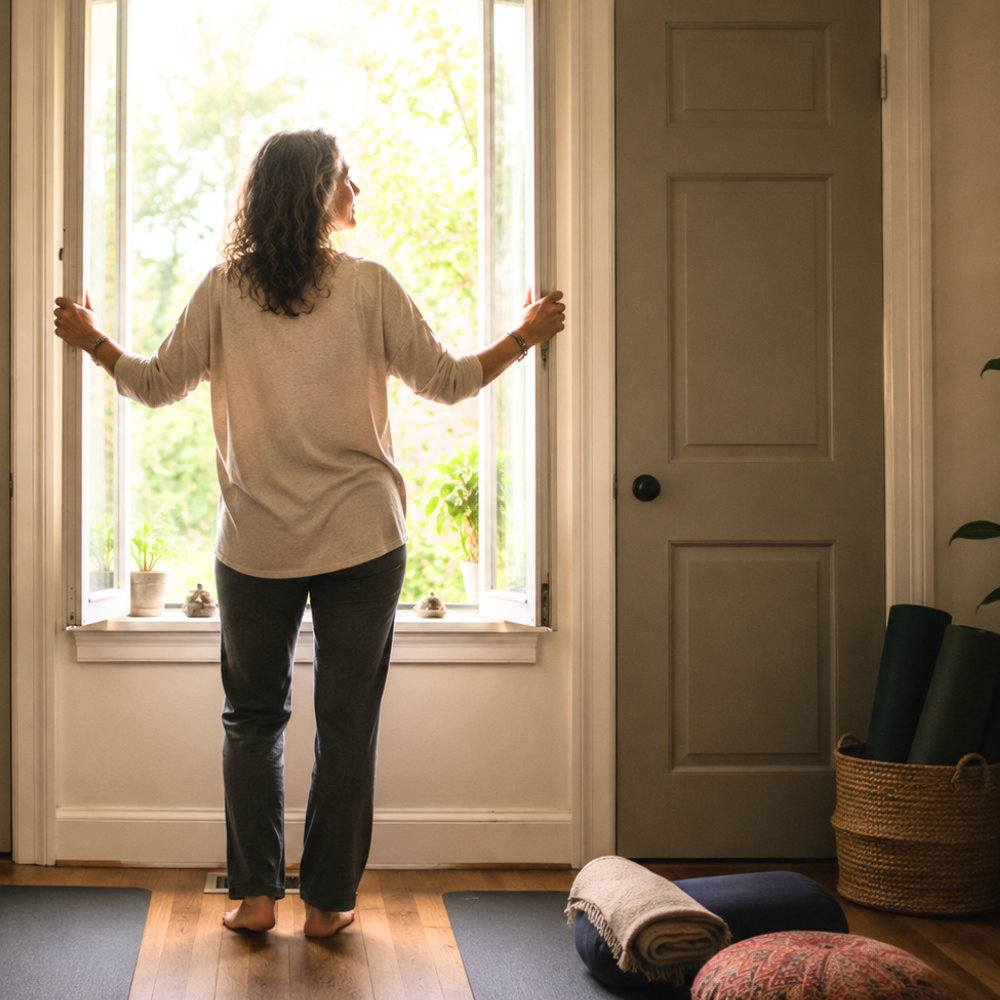
Opening a Window
I think of Neurodivergent Yoga as opening a window when all the doors feel closed.
My approach is to use all the tools of yoga, not just poses, to help late-diagnosed ADHD and neurodivergent women like me understand themselves better, see new possibilities, and build the kind of self-trust that comes from knowing how to work with what nature gave us instead of fighting against ourselves.
That sounds simple.
But in practice, it changes everything.
What We Actually Work On
Most women don't seek out yoga because they want to perfect a pose.
They come because they're tired.
They're burned out.
They're overwhelmed.
They don't trust their energy.
They can't tell what they need.
They keep pushing until they crash.
They know something has to change but they're not sure where to start.
That is the work we do together.
We learn how to recognize the difference between energy and urgency.
We learn how to notice overwhelm before it takes over.
We learn how to work with attention instead of constantly fighting it.
We learn how to understand capacity and stop treating it like a character flaw.
We learn how to recognize clues from the body before they become emergencies.
And over time, we learn how to trust ourselves again.
More Than Poses
Movement is part of Neurodivergent Yoga, but it is not the whole story.
We also use breath, meditation, self-study, reflection, nervous system awareness, yoga philosophy, and simple everyday practices that help us understand what is happening beneath the surface.
Some of these practices happen on a yoga mat.
But most of them happen in the middle of ordinary life.
While making plans.
While recovering from a busy day.
While deciding whether to say yes or no.
While noticing we've reached our limit.
While trying to figure out what we need before burnout makes the decision for us.
How We Get Started
Many of us spent years trying to become more productive, more consistent, more disciplined, or more regulated.
Neurodivergent Yoga starts somewhere else.
We learn how to understand and listen to ourselves so we can rebuild self-trust.
As late-diagnosed neurodivergent women, many of us learned to work against ourselves in order to keep going. We learned to override clues, ignore limits, and question our own experience.
This work helps us rebuild that relationship.
We learn how to:
notice clues
honor capacity
respond with care
practice returning to what helps
build self-trust
And over time we bring what we learn into our real life.
Yoga is the method.
Self-trust is the transformation.
Real life is where we practice.