Why Knowing What Helps Still Doesn’t Mean You Can Do It

There’s a unique kind of shame that comes from knowing what could help you feel better and still not being able to do it.
You know you need to eat. You know you need water. You know going outside would help. You know getting off your phone would help. You know starting the laundry, answering the text, taking a shower, or getting into bed earlier would help. You know.
And still, there you are.
Frozen, drifting, avoiding, circling, or doing everything except the thing you meant to do.

A lot of neurodivergent people live in this space.
I know I have. Enough times that it changed the way I understand support, wellness, and yoga itself.
For a long time, I thought the issue was follow-through. I thought I needed more discipline, a tighter routine, a better plan, and more self-control. I thought the answer was to push harder and finally become the kind of person who did what helped when it counted.
That approach never got me very far.
The issue was never a lack of knowledge. I already knew a lot. Most of us do. We read, research, save, organize, think, plan, and try. We know what is “good for us.” We know what people recommend. We know what has helped before. We know the basics. Eat. Rest. Move. Pause. Breathe. Start earlier. Make it simple. Get off the screen. Do one small thing.
And still, so often, we cannot do it when the moment comes.
The gap nobody talks about enough
A lot of wellness advice starts too late.
It starts after you already have the energy to act. After you are already able to choose, begin, shift gears, and follow through. It assumes the hardest part is knowing what to do. For a lot of neurodivergent people, that is not the hardest part at all!
The hardest part is the gap between knowing and doing.
That gap can look like sitting on the couch knowing you need food and still not being able to get up. It can look like feeling yourself getting more dysregulated while continuing to scroll because the thought of transitioning feels too big. It can look like knowing sleep would help while staying up anyway because your system does not know how to downshift. It can look like staring at a simple task and feeling your whole body resist it like it weighs fifty pounds.
From the outside, it looks small. But from the inside? Shame, stories, and very often a lot of emotional pain.
And when this happens often enough, it starts to shape how you see yourself. You tell yourself you are inconsistent. You say you have no follow-through. You start treating your own struggle like proof you cannot trust yourself. You become both the person who is stuck and the person standing over yourself judging it.
That does real damage over time.
Knowing is not the same as capacity
This is one of the biggest things I wish more people understood.
Knowing what helps is not the same as having access to it in the moment!
Insight is not the same as capacity. Caring is not the same as being able to act. Wanting support is not the same as being able to reach for it when your nervous system is overloaded, your body is tired, your brain is scattered, and the transition in front of you feels bigger than it looks on paper.
You can care deeply and still be stuck.
You can know exactly what might help and still not be able to begin.
You can want to feel better and still not be able to make the next move.
That does not mean you are lazy. It does not mean you do not want it badly enough. It does not mean you are failing at basic life. It means there is more going on in the moment than most advice accounts for.
What is happening in that moment
Sometimes it is executive function strain. Sometimes it is sensory overload. Sometimes it is hunger mixed with decision fatigue. Sometimes it is transition paralysis. Sometimes it is the after-effect of masking, peopling, coping, adapting, and pushing all day long. Sometimes your body is reacting before your thoughts catch up.
Too many of us have spent years blaming ourselves for moments that make more sense when we have the ability to look at them through the lens of our neurodivergent nervous system.
Not to excuse everything. To understand it.
This lens, this point of view matters!
Because once you stop reading every hard moment as a character flaw, you can start asking better questions.
What time of day gets harder for me?
What happens right before I disappear into my phone?
What kinds of decisions drain me fastest?
What transitions knock me flat?
What does my body feel like when I know what I need but still cannot move toward it?
What repeats?
Those questions have helped me, and slowed my shame spiral to a crawl.
Why neurotypical advice can be harmful
A planner does not fix shutdown.
A perfect morning routine does not fix overload.
A meal prep checklist does not fix the moment when your brain and body both say no.
“Just do one thing” isn’t wrong, but it skips over the reality that even one thing can feel unreachable in a dysregulated moment.
This is why so many neurodivergent people get left behind by mainstream wellness. The advice sounds simple, but it is built for people who still have access to initiation, decision-making, and transition energy in the moment they need it.
When you don’t? The advice just turns into one more thing you failed at.
That is why so many smart, thoughtful, caring people end up feeling like they are somehow bad at taking care of themselves. They are measuring themselves against support that was never built for the moment they are actually in.
What helps instead
The biggest shift that helped me was not just knowing the truth about how my brain and body work, but accepting it and acknowledging it openly.
The truth is that many of us do not need more information. We need more support inside the moment where action breaks down.
Simple support might look small to an outsider, but for us? It can mean the difference between missing the meal and eating something, staying stuck for three more hours and getting moving, shutting down harder and catching the moment sooner.
Don’t let anyone dismiss those moments, because they count.
A piece of toast counts. A glass of water counts. Stepping outside for one minute counts. Lying on the floor counts. Doing the less complicated version counts. Beginning badly counts.
These moments matter because they start to rebuild trust.
Not trust based on perfection. Trust based on listening to what you need, versus someone telling you what you need.
Start with the moment you’re in
If you know what would help and still cannot do it, stop using that moment as proof that there is nothing you can do about it.
Use it as information.
Ask yourself what is making this harder right now.
Maybe you are hungry and overwhelmed.
Maybe you are too tired to make decisions.
Maybe you are trying to do the ideal version when the reachable version is what is available.
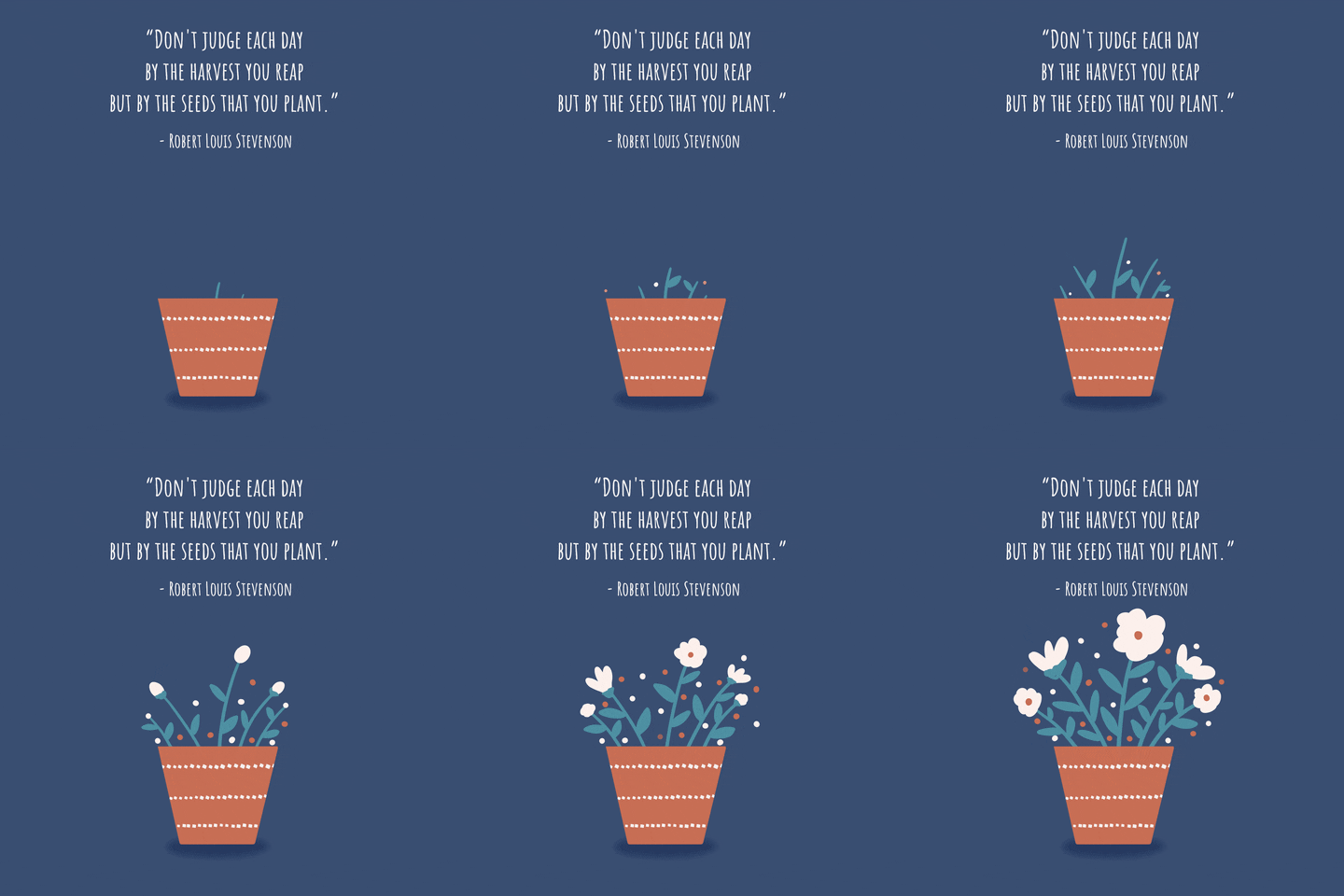
Then take a small step.
Not with a big reset. Not with a perfect plan. With the next step that is small enough to do from the state you are already in.
Not “make a healthy meal.”
More like “eat the toast,” “heat the soup,” or “drink the water.”
Not “turn the whole day around.”
More like “help this moment.”
That is where a lot of self-trust starts to come back.
Not when you do everything right.
When you stop abandoning yourself in the moment things get hard.